Tampilkan postingan dengan label Banking. Tampilkan semua postingan

Selasa, 27 September 2016

EconTalk

I did an EconTalk Podcast with Russ Roberts. The general subject is economic growth, the reasons it seems to be slipping away from us and policies (or non-policies) that might help.

As in other recent projects (growth essay, testimony) I'm trying to synthesize, and also to find policies and ways to talk about them that avoid the stale left-right debate, where people just shout base-pleasing spin ever louder. "You're a tax and spend socialist" "You just want tax cuts for your rich buddies" is getting about as far as "You always leave your socks on the floor" "Well, you spend the whole day on the phone to your mother."

We did this as an interview before a live audience, at a Chicago Booth alumni event held at Hoover, so it's a bit lighter than the usual EconTalk. This kind of thought helps the synthesis process a lot for me.  Russ' pointed questions make me think, as did the audience in follow up Q&A (not recorded). Plus, it was fun.

I always leave any interview full of regrets about things I could have said better or differently. The top of the regret pile here was leaving a short joke in response to Russ' question about what the government should spend more on. Russ was kindly teeing up the section of the growth essay "there is good spending" and perhaps "spend more to spend less" ideas in several other recent writings. It would have been a good idea to go there and spend a lot more time on the question.


From the growth essay, I think the government could profitably spend a lot more money on the justice system. That so many of our fellow citizens rot in jail awaiting trials, that the vast majority never receive a trial anyway but a hasty plea-bargain, that their legal representation is so thin, is a disgrace -- and causing huge problems. If a wrongly accused young man spends two years in jail before charges are dropped, the consequences for him and his family are awful. Business relies on a speedy and efficient justice system to adjudicate commercial disputes, and that seems to be falling apart too, partly for lack of resources.  The cost here is peanuts compared to, say, peanut subsidies.

Our public infrastructure doesn't just consist of steel and asphalt. The public software needs investment as well, or more.

Public health is one of the most essential public goods. Of all the civilization-ending scenarios you can think of, nuclear war and a pandemics top my list. Many past pandemics followed a surge in globalization -- the plague of the 1350s, that wiped out half or more of the population; the smallpox that wiped out native America in the 1500s, the 1918 flu. (Larry Summers has a good article on this point.) We are ripe for antibiotics to stop working and new diseases to spread catastrophically, if not among humans among the plants and animals on which we depend. Don't count on the UN and the WHO.

The government can profitably fund basic research. "Yes, 95% of funded research is silly. Yes, the government allocates money inefficiently. Yes, research should also attract private donations. But the 5% that is not silly is often vital, and can produce big breakthroughs." (Basic research is not the same thing as subsidies for commercializing research.)

Yes, Martha, I should have said, there are public goods here and there.

Of course, more spending on things like these does not imply more spending overall. They're all remarkably cheap, and could easily be funded by spending a little less on some of the colossal waste. (Example: We spend $6 billion on the FBI and $13 billion on border control.) Of course, one must also spend wisely and use the results wisely. And one could add a lot to the list. But repeating a fun joke about spending is not the right answer.


Kamis, 01 September 2016

Settlement skulduggery

Andy Koenig had a WSJ oped on a subject getting far too little attention. When the government goes after big companies such as banks, and obtains huge out of court settlements, just where does the money go?
...In conjunction with the Justice Department, the RMBS Working Group ["a coalition of federal and state regulators and prosecutors"] has reached multibillion-dollar settlements with essentially every major bank in America.

...in April ... the Justice Department announced a $5.1 billion settlement with Goldman Sachs. In February Morgan Stanley agreed to a $3.2 billion settlement. Previous targets were Citigroup ($7 billion), J.P. Morgan Chase ($13 billion), and Bank of America,... $16.65 billion...
The money does not go to any individual who demonstrably lost money as a result of the banks' actions. Instead,
... a substantial portion is allocated to private, nonprofit organizations drawn from a federally approved list. Some groups on the list—Catholic Charities, for instance—are relatively nonpolitical. Others—La Raza, the National Urban League, the National Community Reinvestment Coalition and more—are anything but.

...Many of these groups engage in voter registration, community organizing and lobbying on liberal policy priorities at every level of government. They also provide grants to other liberal groups not eligible for payouts under the settlements...


...Most of the deals give double credit or more against the settlement amount for every dollar in “donations.” Bank of America’s donation list—the only bank to disclose exactly where it sends its money—shows how this benefits liberal groups. The bank has so far given at least $1.15 million to the National Urban League, which counts as if it were $2.6 million against the bank’s settlement. Similarly, $1.5 million to La Raza takes $3.5 million off the total amount of “consumer relief” owed by the bank...

As part of their “consumer relief” penalties, Bank of America and J.P. Morgan Chase must also pay a minimum $75 million to Community Development Financial Institutions—taxpayer-funded groups propped up by the Obama administration as an alternative to payday lenders. “Housing Counseling Agencies” also get at least $30 million. This essentially circumvents Congress’s recent decision to cut $43 million in federal funds routed to these groups through the Department of Housing and Urban Development.

The politicians who negotiate the settlements as part of the RMBS Working Group have also directed money to their supporters and states. Illinois’s Democratic attorney general Lisa Madigan announced she had secured $22.5 million from February’s Morgan Stanley deal for her state’s debt-ridden pension funds—a blatant payout to public unions. The deals with J.P. Morgan Chase, Bank of America and Citigroup yielded a further $344 million for both “consumer relief” and direct payments to pension funds.

New York hit the jackpot too. Attorney General Eric Schneiderman, also a Democrat and chairman of the RMBS Working Group, arranged for Morgan Stanley to fork over $400 million to New York nonprofits and $150 million to the state.
I wrote about this quite a while ago, when I was astonished to find the Federal Reserve going along with the DOJ and attorneys general, using its "safety and soundness" regulatory power to force banks to give money to activist groups.

This story rings a few bells.

1) Regulation. What's wrong with regulation and economic law is not really "too much" or "too little" -- the standard old argument --but how it works -- the steady politicization of economic law and regulation, the decline in rule-of-law protections, the increasing use of the Administrative state to force political compliance.

Why didn't the banks fight? Why didn't they object to where their money was going? Why do they (except B of A) not even disclose their "charitable" contributions under the settlement? The government, now with the Fed along for the ride, can really make their lives difficult, of course! Hefty speaking fees to likely political officials, a strong revolving door to Washington, and keeping the payments secret are cheap investments to keep this sort of thing at bay.

2) Nonprofits. The public image of nonprofits are Red Cross, or Stanford. As you can see, many "nonprofits" have become a way to funnel money to politics.  I'd like to get rid of "nonprofits," or to the corporate tax and estate tax which creates nonprofits.  I think the good ones will survive. The substitution effect should outweigh the income effect.

3) Spending. Another tired argument is too much vs. too little spending. But look how our government manages to direct A to give to B, all the while keeping the tax and spending off the books.


What to do? Koenig suggests
... Rep. Bob Goodlatte (R., Va.) introduced a bill in April that would prevent government officials from enforcing settlements that funnel money to third parties, and it needs to gain wider traction with his colleagues. The political shakedowns disguised as public service must end.
This does seem like a practice that Congress could end, this way or others. Any money paid in a legal settlement must go to people actually hurt by the illegal action, or to the US Treasury.

There isn't a magic bullet. The dissolution of rule of law has to be met by, well, laws with rules in them.

Senin, 08 Agustus 2016

A world without cash

Max Raskin and David Yermack have a nice WSJ OpEd last week, "Preparing for a world without cash." The oped summarizes their related paper.
What would a government-backed digital currency look like? A country’s central bank would need to become a deposit-taking institution and hold accounts on behalf of citizens and businesses. All of their debits would be tracked on the central bank’s blockchain, a digital ledger resistant to tampering. The central bank would pay interest electronically by adjusting the balances of depositor accounts.
I'm a big fan of the idea of abundant interest-bearing electronic money, and that the Fed or Treasury should provide abundant amounts of it. (Some links below.) Two big reasons: First, we then get to live Milton Friedman's optimal quantity of money. If money pays interest, you can hold as much as you'd like. It's like running a car with all the oil it needs. Second, it is a key to financial stability. If all "money" is backed by the Treasury or Fed, financial crises and runs end. As Max and David say,
Depositors would no longer have to rely on commercial banks to hold their checking accounts, and the government could get out of the risky deposit-insurance business. Commercial banks that wished to keep making loans would raise long-term capital in the debt and equity markets, ending the mismatch between demand deposits and long-term loans that can cause liquidity problems.
However, there are different ways to accomplish this larger goal. Do we all need to have accounts directly at the Fed, and is a blockchain the best way for the Fed to handle transfers?


The point of the blockchain, as I understand it, is to demonstrate the validity of each "dollar" by keeping a complete encrypted record of its creation and each person who held it along the way.
Its archival blockchain links together all previous transfers of a given unit of currency as a method of authentication. The blockchain is known as a “shared ledger” or “distributed ledger,” because it is available to all members of the network, any one of whom can see all previous transactions into or out of other digital wallets
That, and a limited supply to control its value, was the basic idea of bitcoin. But when we are clearing transactions by transferring rights to accounts at the Fed, the validity of the "dollar" is not in question. It's at the Fed. And, the big advantage relative to bitcoin as I see it, the value of the dollar comes from monetary policy and ultimately the government's demand for "dollars" to be paid in taxes, not from a fixed supply as was the case with gold.

The blockchain also appears to clear transactions more quickly and offer some security advantages. The latter are very attractive -- in my personal life I've recently had the questionable pleasure of spending days enjoying 19th century finance of multi-day clearing times, obtaining notarized signatures and medallion guarantees, and sending pieces of paper around. But not yet ironclad -- The same week of the WSJ has a string of articles on the security of  Bitcoin following a recent hack.

The biggest stumbling block in my mind is "all members of the network, any one of whom can see all previous transactions into or out of other digital wallets." Per Max and David, this has pluses and minuses:
Tax collection would become much simpler, and tax evasion and money laundering could become prohibitively difficult.
Yet the centralization of banking under this system would also create a Leviathan with the power to monitor and control the personal finances of every citizen in the country. This is one of the chief reasons why many are loath to give up on hard currency. With digital money, the government could view any financial transaction and obtain a flow of information about personal spending that could be used against an individual in a whole host of scenarios. 
This really is a big change in how "money" works. Traditional cash has a lovely property, that it has no memory. Its physical properties determine its value in a way independent of its history. It is incredibly efficient, in a Hayek information sense. The economy does not need the memory of every transaction. Blockchains turn this around.

The anonymity of cash makes it enduringly popular -- cash holdings are up, not down in the digital age. The same week of WSJ reading had articles delving into the continuing popularity of cash, and the mechanics of handling it, the ongoing fury over the planeload of cash delivered by the Obama administration to Iran. It's not hard to figure out why both Iranians and Administration needed to send old-fahshioned bills on an unmarked plane, not a wire transfer.

Indeed creating this Leviathan is a danger, to the economy, and to our political freedom. Our government likes to pass aspirational laws that we don't really mean to enforce. Get rid of cash, and allow the government to see every transaction and enforce every law regarding payment of anything, and 11 million immigrants suddenly can't work at all and become penniless. Rigorous enforcement of all transactions would not only stop your kids lemonade stand and babysitting business, it would wipe out most of the employment opportunities for lower-income America. Many businesses would come to a halt.

The natural response is, well, maybe we shouldn't pass laws we don't really mean to enforce. Good luck with that.

More deeply,  "flow of information about personal spending that could be used against an individual in a whole host of scenarios" is truly frightening. I don't think there is a political candidate in the whole country who could not be embarrassed with one purchase at some point in their lives. Consider the brouhaha now over "disclosure" of political contributions -- there is a real fear that disclosure is a way of setting up hit lists for the administration to go after its political enemies. Multiply that by a thousand. Dissenters could easily be silenced if the government can monitor or block every transaction.

The ability to transact with anonymity and privacy has been a central freedom for hundreds of years. It's largely gone already. Losing it entirely and giving the government huge power to enforce any law it passes is not necessarily a good thing.

Mike and David opine
creating and respecting privacy firewalls and rethinking legal-tender laws could mitigate the dangers of monopoly and stifled competition in currency markets.
[Subject-free sentences (creating?) are always a sign of trouble!] The dangers are not of monopoly and competition, the dangers are in the vast loss of privacy that the government, and its leakers and hackers knowing all our transactions implies.

(Here I'm out on a limb on my blockchain knowledge, but I gather that one does have to wipe the slate clean occasionally. Otherwise, the blockchain gets ridiculously long. Imagine each dollar, a hundred years from now, attached to a list of everyone who has ever held it! That wiping out process could do a lot for privacy.)

So, back to basics. It is not at all clear to me in their analysis why the Fed has to manage all the accounts. The Fed, Treasury, and the government in general are very good at defining the units of a currency, and providing an easy standard of value -- cash, coins, liquid government debt, reserves.  That is their natural monopoly. I don't see that the government has a similar natural advantage in providing low-cost transactions services, especially on monitoring fraud in the use of those services. The Fed got hacked by employees of the central bank of Bangladesh.

So I leave with two big questions -- and these are questions, and this is an invitation to more thought.

Is a blockchain really better than accounts at the Fed, and instructions to flip a switch to send money from my account to your account? What is the best way to get low transactions costs and fraud prevention, given that we don't need authentication of the dollar itself and a supply limitation?

Is it really better for the Fed to handle all transactions directly, rather than for the Fed to provide clearing accounts, and "banks" (narrow!) to provide transactions services between people, using reserves as now for netting and clearing? The latter setup allows competition and innovation in transactions services, and a better hope for an information firewall retaining some privacy and anonymity in transactions.

(Note for readers new to the blog: I've written about some of these issues in  A new structure for US Federal Debt, Toward a run-free financial system, A blueprint for effective financial reform and previous blog posts, such as here.)

Rabu, 22 Juni 2016

Rajan on cash transfers and corruption

Raghu Rajan, who just announced he is stepping down as Governor of the Central Bank of India, gave a very interesting speech, that bears among other things on the question of social programs vs. cash transfers.

A big problem with government provided assistance in India is that the provision is corrupt:
Our [India's] provision of public goods is unfortunately biased against access by the poor. In a number of states, ration shops do not supply what is due, even if one has a ration card – and too many amongst the poor do not have a ration card or a BPL card; Teachers do not show up at schools to teach; The police do not register crimes, or encroachments, especially if committed by the rich and powerful; Public hospitals are not adequately staffed and ostensibly free medicines are not available at the dispensary; …I can go on, but you know the all-too-familiar picture.
Raghu has a thoughtful observation on what keeps this system going:


This is where the crooked but savvy politician fits in. While the poor do not have the money to “purchase” public services that are their right, they have a vote that the politician wants. The politician does a little bit to make life a little more tolerable for his poor constituents – a government job here, an FIR registered there, a land right honoured somewhere else. For this, he gets the gratitude of his voters, and more important, their vote.
...perhaps the system tolerates corruption because the street smart politician is better at making the wheels of the bureaucracy creak, however slowly, in favour of his constituents. And such a system is self-sustaining. An idealist who is unwilling to “work” the system can promise to reform it, but the voters know there is little one person can do. Moreover, who will provide the patronage while the idealist is fighting the system? So why not stay with the fixer you know even if it means the reformist loses his deposit?
So the circle is complete. The poor and the under-privileged need the politician to help them get jobs and public services. The crooked politician needs the businessman to provide the funds that allow him to supply patronage to the poor and fight elections. The corrupt businessman needs the crooked politician to get public resources and contracts cheaply. And the politician needs the votes of the poor and the underprivileged. Every constituency is tied to the other in a cycle of dependence, which ensures that the status quo prevails. 
The Mafia may have had a similar equilibrium

What to do? Cash transfers are an attractive option
... money liberates. Could we not give poor households cash instead of promising them public services? A poor household with cash can patronize whomsoever it wants, and not just the monopolistic government provider. Because the poor can pay for their medicines or their food, they will command respect from the private provider. Not only will a corrupt fair price shop owner not be able to divert the grain he gets since he has to sell at market price, but because he has to compete with the shop across the street, he cannot afford to be surly or lazy. The government can add to the effects of empowering the poor by instilling a genuine cost to being uncompetitive – by shutting down parts of the public delivery systems that do not generate enough custom.
Much of what we need to do is already possible. The government intends to announce a scheme for full financial inclusion on Independence Day. It includes identifying the poor, creating unique biometric identifiers for them, opening linked bank accounts, and making government transfers into those accounts. When fully rolled out, I believe it will give the poor the choice and respect as well as the services they had to beg for in the past. It can break a link between poor public service, patronage, and corruption that is growing more worrisome over time.
...if there is evidence that cash transfers are being misspent – and we should let data rather than pre-conceived notions drive policy -- some portion could be given in the form of electronic coupons that can be spent by the specified recipient only on food, education or healthcare.
 A good summary
 One of the greatest dangers to the growth of developing countries is the middle income trap, where crony capitalism creates oligarchies that slow down growth. [Just developing countries?!] ... To avoid this trap, and to strengthen the independent democracy our leaders won for us sixty seven years ago, we have to improve public services, especially those targeted at the poor. A key mechanism to improve these services is through financial inclusion, which is going to be an important part of the government and the RBI’s plans in the coming years.
Raghu's efforts to reform India's banking and financial system deserve more notice.

(PS: Blogging will be a little spotty for the next week and a half, as I'm off at a glider competition.)

Rabu, 15 Juni 2016

Financial Choice

If you're interested in policy rather than politics, the package of legislative proposals coming out of Congress are a lot more interesting than the Presidential race at the moment. Speaker Paul Ryan is rolling out "A Better Way" package and Rep. Jeb Hensarling has just announced a "financial CHOICE act" to fundamentally reform Dodd-Frank. (Most quotes are from Jeb Hensarling's speech at the Economic Club of New York. See also  NYT coverage.)

These efforts will, I think, become much more important later on. The presidential race will decide whether this agenda can survive the instant veto that it faces now.  (This is a non-partisan comment. Hilary Clinton could likely assure a landslide by announcing she will work with Paul Ryan to craft and pass it.)

In any case, it defines a clear program that may be the focus of economic policy under a presidency of either party. And I think that's healthy as well.  We are still living in the shadows of Franklin Roosevelt's 100 days, and an increasingly imperial presidency. But the current need is not for a flurry of new legislation and executive orders to address a crisis. We need a steady clean-up of the legal and regulatory mess of the last few decades. For that project, it may be better for policy leadership to come from Congress, and by careful and patient drafting of actual legislation.

The legislation is still being drafted, which is why it would be lovely if more of the media and blogosphere were paying attention rather than to the latest antics of the presidential candidates. The congressional staff writing these things are paying attention and the proposals can be refined!

Today, a look at the Financial CHOICE act.

More capital, and the carrot of less regulation
...there is a growing consensus surrounding the idea of a tradeoff between heightened capital levels and a substantially lower regulatory burden....[We] will relieve financial institutions from regulations that create more burden than benefit in exchange for meeting higher, yet simple, capital requirements...Think of it as a market-based, equity financed Dodd-Frank off- ramp... the option remains with the bank.

How to measure capital? This is a hard nut.
...banks that maintain a simple leverage ratio of at least 10 percent and, at the time of the election, have a composite CAMELS rating of 1 or 2 may elect to be functionally exempt from the post-Dodd-Frank supervisory regime, the Basel III capital and liquidity standards, and a number of other regulatory burdens that pre-date Dodd-Frank. 
This is an element worthy of more discussion. Leverage ratios have problems too, as they do not distinguish the riskiness of assets.  CAMELS ratings have their own problems.

As blog readers know, I think we can keep going well beyond 10% capital. I'd like to see steady incentives for more and more capital, rather than an arbitrary threshold.  My current thinking leads to reducing subsidies for debt, a fee on short term debt, and using ratios of market value of equity to debt. Or a schedule of regulatory reductions: so much for 10% capital, more for 20% capital, do what you want at 100%. But we're in danger here of repeating a Libertarian party sort of fight whether there should be drivers' licenses in Nirvana, so let's leave this as an open question for refinement.

It seems natural to ask for more capital on riskier assets, but a beautiful paragraph on risk-weights explains why that doesn't work.
Risk-weighting is simply not as effective. First, it is far too complex, requiring millions of calculations to measure capital adequacy. Second, it confers a competitive advantage on those large financial institutions that have the resources to navigate its mind-numbing complexity. Third, regulators have managed to get the risk weights tragically wrong, for example, treating toxic mortgage-backed securities and Greek sovereign debt as essentially risk-free. One myopic globally imposed view of risk is itself risky. Finally, risk-weighting places regulators in the position of micro-managing financial institutions, which politicizes credit allocation. Witness the World Bank recently advertising its zero risk rating under the Basel Accords for their “green bonds.”
The regulatory carrot: A bank with enough capital
would be deemed “well capitalized” for prompt corrective action purposes; It would no longer be subject to Basel Committee capital or liquidity requirements as implemented by the U.S. banking regulators;  It would be able to make capital distributions freely; and would additionally be able to consummate transactions without being subject to the regulatory challenge of increasing risk to the stability of our banking or financial system, or on grounds related to capital or liquidity standards of concentrations of deposits or assets. 
... no Federal rule establishing “heightened prudential standards” of the type provided for in Dodd-Frank would apply to qualifying banking organizations, including the living will requirement...In short, a strongly capitalized qualifying bank will be enabled to remove government bureaucrats from its boardroom and lend and invest freely.
From the executive summary,
Exempt banking organizations that have made a qualifying capital election from any federal law, rule, or regulation that permits a banking agency to consider risk “to the stability of the United States banking or financial system,” added to various federal banking laws by Section 604 of the Dodd-Frank Act, when reviewing an application to consummate a transaction or commence an activity.
A linguistic note: Not once in this speech, except while quoting others, does Rep. Hensarling use the phrase "to hold" capital. Every instance is "raise" capital. And explicitly, 
equity capital can be put to work no differently than debt or deposits. It is not money put under a mattress.
And as to the ballyhooed impossibility of raising capital, 
U.S. banks have raised hundreds of billions in new capital
Who says nobody in Congress understands finance!

Bankruptcy; no more "designation"  

The centerpiece of Dodd-Frank is the FSOC (Financial Stability Oversight Council's) ability to "designate" a firm as "systemically important," and then to "resolve" it, in place of bankruptcy.  This will go.
...bankruptcy, not bailouts. Recently the House passed the bipartisan Financial Institution Bankruptcy Act, which creates a new subchapter of the Bankruptcy Code tailored to specifically address the failure of a large, complex financial institution.....
The speech goes on with several good reasons bankruptcy is better than resolution.  I hear cheering from John Taylor's office already.
 Retroactively repeal the authority of the Financial Stability Oversight Council (FSOC) to designate firms as systematically important financial institutions (SIFIs) 
Fed Lending
...we impose on the Fed Bagehot’s famous dictum: lend freely, but only to solvent institutions, only against sound collateral, and only at interest rates high enough to dissuade those who are not genuinely in need. 
I'm a little leery of this one. Dictums are not analysis. If you want to stop a run, you have to lend pretty freely. Private institutions like a clearinghouse to do that once existed, but they have been put out of business by the Fed.  Nobody knows who is solvent vs. illiquid; the point of a run is that collateral that was "sound" yesterday is not today.  And if you want to stop a run, who cares if it's insolvent or illiquid? The Fed doesn't need quickly salable collateral, being super senior in bankruptcy is enough.  Bagehot's dictum is a great way to run a hedge fund. It's not necessarily the right way to run a central bank.

I worry that we are headed for the worst of all worlds -- people expect bailouts and free fed lending, but the government is legally constrained from doing so. All the moral hazard and none of the crisis mop. If we're going to go in this direction, it has to be crystal clear to people running banks that the government will not be able to step in next time, even stretching laws, and they'd better set things up carefully ahead of time. I'm afraid people are not going to believe any legal restrictions.

Rule of Law

Some of the most interesting parts of this proposal really belong together in "restoring the rule of law to regulation." That's a big project that I hear simmering in much of this Congressional planning. And, based on the daily news (for example the latest on the FCC takeover of the internet) not a minute too soon.

CFPB 

The "Consumer Financial Protection Bureau" is out of control.
fundamentally reforming the CFPB......task it with the dual mission of consumer protection and competitive markets, with a cost-benefit analysis of rules performed by an Office of Economic Analysis. 
 Replace the current single director with a bipartisan, five-member commission which is subject to congressional oversight and appropriations. 
... Repeal authority to ban bank products or services it deems “abusive” and its authority to prohibit arbitration. ... Repeal indirect auto lending guidance.
Federal Reserve 

One of the most thought-provoking proposals splits the Federal Reserve's regulatory power from its monetary policy power. It puts bank regulation, like all regulation, in the rule-of-law framework that is supposed to exist for regulation: cost-benefit analysis, Administrative Procedures Act, Congressional oversight, and so forth. Various quotes: 
Require that the different sets of conditions under which stress tests are evaluated subject to notice and comment period. 
... makes sure every financial regulation passes a rigorous cost-benefit test... 
We will put all the financial regulatory agencies on budget. The bare minimum level of accountability to “We the People” is to have their elected representatives in Congress control the power of the purse, as inscribed in our Constitution. 
But, wisely,
protects the Federal Reserve’s independence in conducting monetary policy by leaving that function off-budget. The Fed’s prudential regulatory and financial supervision activities, however, will now be subject to the normal and transparent congressional appropriations process.
SEC
...due process rights. Too many citizens have been “shook down” or abused by their government. Thus we will provide an immediate right of removal to federal court for respondents in administrative proceedings.  We will ensure that disciplinary proceedings are public, that all fines imposed by regulatory agencies are sent to the Treasury for deficit reduction, that regulatory entities created by Congress are subject to full congressional oversight, and that other due process rights are strengthened.
There is a curious section on increasing the SEC's power:
the Financial CHOICE Act will impose the toughest penalties in history for financial fraud, self- dealing and deception.
We will double the cap for the most serious securities law violations and will allow for triple monetary fines when penalties are tied to illegal profits. We will give the SEC new authority to impose sanctions more closely linked to investor losses – and increase punishments even more for repeat offenders. We will increase the maximum criminal fines for both individuals and firms that engage in insider trading.
I'm not aware of a big problem in the SEC (and DOJ) not being able to ruin people's lives adequately, or extort large enough settlements from banks. Perhaps this is an olive branch, which won't hurt much.

Broader project

A sense of the broader project to restore rule of law in regulation.
Dodd-Frank gives FSOC the ability to designate companies as Too Big to Fail if it “determines that material financial distress” at the company “could pose a threat to the financial stability of the United States.” But nowhere in Dodd-Frank, or anywhere else in the U.S. Code for that matter, are these terms defined. So by defining these vague terms in any fashion that pleases them, this “super-group” of regulators can exert ultimate functional control over almost any large financial firm in our economy, and do so with utter disregard for due process. This is not the rule of law; it is the rule of rulers, and it’s an anathema to a free and democratic society.... 
Next, we repeal the Chevron doctrine requiring the judiciary to give deference to financial regulatory agencies’ interpretation of the law. The doctrine is unfair and an affront to due process and justice. 
I've gone on long enough. Legislation needs a public comment mechanism too, as this is  a big package, which though on a very good track can surely be refined a bit.


Rabu, 25 Mei 2016

Equity financed banking video


Video of my talk at the Minneapolis Fed's "Ending Too Big to Fail" symposium. A link to the video (youtube) in case you don't see the above embedded version. The event webpage, with links to the other talks and the agenda.  Summary: AM: Dodd Frank is a big failure, we need a big fix. PM: We'll get it to work with little fixes here and there. I posted the text of my talk earlier.

Selasa, 17 Mei 2016

Equity-financed banking

I gave a talk at the Minneapolis Fed's "Ending Too Big to Fail" symposium, May 16. Agenda and video of the event here.

My  talk is based on "towards a run-free financial system," and a bit on a new structure for federal debt, and blog readers will notice many recycled ideas. But it incorporates some current thinking both on substance and on marketing -- the proposal is so simple, most of the work is on meeting objections.

Here's my talk. This is also available as a pdf here.

Equity-financed banking and a run-free financial system

Premises

We have to define what “sytstemic” and “crisis” mean before we can try to fix them.

My premise is that, at its core, our financial crisis was a systemic run. The mechanism is familiar from Diamond and Dybvig, and especially Gary Gorton’s description of how “information-insensitive” assets suddenly lose that property and become illiquid.

You see a problem at a bank – a word I will use loosely to include shadow-banks, overnight debt, and other intermediaries. You wonder, what about my bank? You don’t really know. The point of short-term debt is that you don’t generally pay attention to the bank’s assets. But you also have the right to take your money out at any time, and the last one out gets the rotten egg. When uncertain, you might as well forego a few basis points of interest and get out now. Everyone does this, and the bank fails.

Runs at specific institutions, caused by identifiable problems, are not really a danger. My story includes a specific “contagion,” that troubles at one institution spread to another, because they cause people to wonder about the other bank’s assets. That “systemic run” element means that banks cant’ easily sell assets to raise cash, or issue new equity.

This description is important for what it denies, and thus for “problems” we don’t have to “solve.”

It’s not a chain of dominoes: A fails, B loses money, B falls, and so forth, so by saving A the whole system is saved.

Contrariwise, even saving A is not enough to assure investors that B’s assets are ok. In fact, saving A might verify investor’s worries about B’s assets, and set off a run!

It’s not huge losses on particularly unsafe assets. Bank assets are not that risky. Bank liabilities are fragile. Small losses spark large runs.

Our crisis and recession were not the result of specific business operations failing. Failure is failure to pay creditors, not a black hole where there once was a business. Operations keep going in bankruptcy. The ATMs did not go dark.

In my premises, the 2000 stock market bust was not a crisis, because it was not a run. Yes, there were huge losses. But when stocks plunge, all you can do is go home, pour a drink, yell at the dog, and bemoan your dumb decisions. You can’t demand your money back from the issuing company, and you can’t drive the company to bankruptcy if it does not pay. Panic selling, even if “irrational,” even if it causes “herding” by others, even if it drives prices down, is not a crisis, and it’s not a run, because the issuing company doesn’t have to do anything about it.

If we want to stop crises, we have to describe when we will say “good enough” and stop trying to fix things in the name of crisis prevention. My premise: an economy with booms and busts, risks taken, and losses transparently absorbed by falling prices, is good enough for now.

If we try to create a financial system in which nobody ever loses money, we will just create a system in which nobody ever takes any risk, and does not fund any remotely risky investment opportunity. That is the direction we are going. And steps that actually matter to fixing crises are getting lost in the effort rush to “fix” every perceived financial “problem.”

(A small random sample of current causes being commingled with crisis prevention, some worthy but separate, some silly: Fannie and Freddie, the community reinvestment act, “predatory lending,” insufficient down payments, FICO scores, Wall Street "greed," executive compensation, credit card fees, disparate-impact analysis, the last names of auto-loan customers, the terms of student loans, hedge fund fees, active management and its fees, “herding” and “crowding” by equity portfolio managers (OFR), over-the-counter versus exchange-traded derivatives, swap margins, position limits, risk-weights, credit ratings, the Volker rule, insider trading, global imbalances, savings gluts, bubbles in houses and stocks, and the ridiculous tiny type on my credit-card agreement.)

I do not mean that other financial regulation is not necessarily bad, or even that one shouldn’t contemplate policies to reduce stock market volatility. But if we actually want to fix crises, or end TBTF, we have to separate those other measures into everyday regulation.

A better world

Given these premises, the central weakness in financial system is clear: fragile, run-prone liabilities.

The answer then is simple too: we should have no more large-scale funding of risky or potentially illiquid assets by run-prone securities – short term debt in particular, but any promise that is fixed-value, first-come first-served, if unpaid instantly bankrupts the company, and in volumes that could even remotely trigger such bankruptcy.

(The caveats here exempt bills, receivables, trade credit, and so on, which are fixed value but not run-prone. “Funding” is the important qualifier. You can trade in short term debt without funding the bulk of investments with it.)

Banks and shadow banks must get the money they use to hold risky and potentially illiquid loans and securities overwhelmingly from run-proof, floating-value assets – common equity mostly, some long term debt. (I say “hold” specifically to distinguish it from “originate” or “make” loans, which are then securitized and sold. )

Once we have done this, financial crises are over. A 100% equity-financed institution cannot fail, and cannot suffer a run. Fail means fail to pay your debts, and if you have no debts you cannot fail.

(OK, technically you can take on such a huge derivatives position that you can lose more than 100% of equity, but it takes very little attention from regulators and analysts to make sure that doesn’t happen.)

Such an institution needs next to no risk regulation, beyond the regular transparency we demand of any public corporation.

Any remaining fixed-value demandable assets must be backed entirely by short-term government debt, or reserves. These are run-proof because there is no doubt on the value and liquidity of the assets (at least for the US, and away from sovereign debt worries, which I also put off the table for now.)

Objections

The major objection is the flow of credit. If banks can’t issue conventional deposits and unconventional short-term debt, they won’t have money to lend and the economy will dry up, the objection goes. Others object similarly that without bank “transformation” of maturity and risk, economic growth would be slower.

This perception is false. Not one cent more or less money needs to be provided, not one iota more risk needs to be shouldered, not one cent less credit need be extended. And I think the case is strong that growth will be substantially higher than the current run-prone but highly regulated system. Let’s look.


Structure (1) is a simplified version of today’s “bank.” There are a lot of complex or illiquid assets. The bank is too complicated to go through bankruptcy. It is funded by very little equity and a huge amount of debt. The debt is prone to runs. (“People” here includes non financial business and institutions such as pension funds and endowments.)

Structure (2) is the simplest equity-financed bank. Banks issue only equity. Households hold that equity, in a diversified form, potentially through a mutual fund or ETF.

In this structure, households provide the same amount of money, and shoulder the same amount of risk, and the bank makes the same amount of loans. But runs and crises are now eliminated.

You will laugh, but I’d like to take this structure seriously. With today’s technology, people can have floating-value accounts.

This was not technically possible in the 1930s, when our country chose instead the path of deposit insurance and risk regulation. But now, you could easily go to an ATM, ask for $20, and it sells $20 of bank shares at the current market value, within milliseconds. “Liquidity” now is divorced from “fixed-value” and “runnable.” Even better, you could go to the ATM, or swipe your card or smartphone, and instantly sell shares in an ETF that holds mortgage-backed securities. This is a “bank,” providing transactions services based on a pool of mortgages and shows that money still flows from people to mortgages. But with floating value, it is run proof.

Unlevered bank equity would have 1/10 or less the volatility it has today. So, we’re talking about something like 2% volatility on an annual basis. Shouldering 2% price volatility is not hard for the majority of depositors (especially dollar-weighted). To argue otherwise, you need some fundamentally non-economic, psychological theory; you need to assert that the same households who are up to their ears in debt, handle 401(k) stock investments, health care copayments, cable and phone bills, and vacation in Las Vegas, can’t somehow stomach 2% volatility in their bank accounts.

(Wait, you ask, the Modigliani-Miller theorem fails for banks, no? The MM theorem for risk is an identity, not a theorem. Risk is not created, destroyed or transformed, it is simply parceled up differently and people end up holding all of it one way or another (even as taxpayers). The contentious part of the MM theorem is whether the price of risk or cost of capital depends on how you slice it. A pizza sliced 10 ways has the same calories, but might sell for more or less than whole.)

But if you want, we can even keep exactly the household assets we have today. Consider structure 3. Banks still issue 100% equity, but that equity is held in a mutual fund, ETF, or similar holding company, which in turn issues debt and equity.

The bank – complex, full of illiquid assets, Ben Bernanke’s specialized human capital, hard to resolve – still can’t fail. The fund can fail. But this failure can be resolved in a morning, and still make it to a 3-martini lunch and golf. The fund’s assets are publicly traded bank equity and nothing else. The bank’s liabilities are common equity and debt. The equity holders get zero, the debt holders get the bank equity. It can be done by computer.

The funds do have debt. But there is little risk of a systemic run on the funds, because their assets are supremely liquid, and visible on a millisecond basis. The failure of one fund need not inspire a run on the next one.

One might object to structure (2) that the Modigliani Miller theorem fails for banks, so it would imply a higher cost of equity. If so, structure (3), by giving households exactly the same assets as they have not, must give exactly the same cost of capital as now — minus the value of taxpayer guarantees.

Structure (3) emphasizes that the issue is not whether “transformation” must occur, whether people really need to hold a lot of fixed-value debt. The issue is whether “transformation,” if it is needed, must be tied to bankruptcy and liquidation of the institution handling the complex assets. One can cook up stories why this must be the case — corporate finance and banking theorists are a clever lot — but are such stories remotely understood and well-tested enough to justify either our occasional crises, or our massive regulatory response? I think not, but I’ll leave that case to be made by our panelists, if they are so inclined.

Structure (3) is a rhetorical point, not a proposal. I do not think it is necessary or desirable to exactly replicate the securities on both ends of the financial system. The point is just that eliminating financial crises by moving to equity-financed banking does not require any new money, any less credit, any less economic growth or any different risk taking. People will likely choose different assets in my world, and thereby improve on it.

Structure (4) elaborates. Not all bank assets are complex and illiquid. Once we remove short-term financing, I suspect that securitized debt and other liquid securities will move off bank balance sheets. They will migrate to long-only floating-value mutual funds and ETFs, and people will move money out of savings accounts and bank CDs into those very safe investment vehicles. The banks will be smaller, holding only those complex and illiquid risks that can’t easily be securitized.

On the other side, banks now have about $2.3 trillion of reserves, (May 5 H.4.1) and $1.2 trillion of demand deposits. Narrow deposit taking is here! We just need to move the deposits and their backing reserves to bankruptcy-remote vehicles (which banks can still operate for a fee, if that makes sense).

How much risk-free assets do people really need? We can provide them up to $14 trillion and counting with narrow deposits backed directly or indirectly (through the Fed) by Treasury debt.

The Fed’s huge balance sheet is a great innovation. Better yet, the Treasury should issue fixed-value floating rate debt so we can all have “reserves.” The last 8 years have taught a revolutionary lesson in monetary economics: huge quantities of interest-bearing money are not inflationary. We can live the Friedman optimal quantity of money, and displace all the private interest-bearing moneys that fell apart in the crisis. As our ancestors got rid of run-prone banknotes in favor of treasury notes, we can get rid of run-prone debt in favor of treasury and fed interest bearing-electronic money. Let’s do it.

How do we get there

We’ve defined and limited the problem, outlined a better world, but we’re still not ready to write regulations. We should check for failures and unintended consequences of current regulations before we go adding new ones.

Our government subsidizes debt, in numerous ways. Let’s start by not simultaneously subsidizing something and also regulating against its use! We can leave that to energy policy.

The tax deductibility of interest payments is an obvious distortion. It’s not the whole story, as nonfinancial corporations don’t all lever this much, but it’s a part of it. I’d rather just get rid of the whole corporate tax, which eliminates demand for a hundred other tax distortions. But treating dividends and interest equally, or better yet reversing the treatment — deduct dividends, not interest — would help.

Implicit and explicit debt guarantees are a bigger part of the distortion in favor of debt. But, while it’s easy to say “end debt guarantees,” I fear the government will always bail out ex-post, and that inability to precommit is an important justification for limiting debt debt. ( V. V. Chari and Patrick Kehoe have elegantly made this case, in “A Proposal to Eliminate the Distortions Caused by Bailouts” Minneapolis Fed Working Paper.)

A lot of law, regulation and accounting subsidizes debt as a liability by privileging it as an asset. Liquidity regulations encourage institutions to hold very short-term debt, with a run option to save themselves individually in times of trouble. Well, that incentivizes someone else to issue that debt, and encourages the fallacy of “sell if things go bad” risk management. Accounting regulations also treat run-prone short-term debt as safe as cash.

Using floating-value funds for transactions purposes would trigger short-term capital gains taxes and an accounting nightmare. That needs to be fixed if we want free liquidity.

In sum, throughout the regulatory system, we should treat non-government short-term debt as poison in the well, both as an asset and as a liability, and we should remove the impediments to the use of liquid floating-value assets. Will this take some effort? Sure. But just carrying the tens of thousands of pages of regulations over to the Dodd-Frank bonfire will take some effort.

Regulatory relief would be a potent carrot and it is my strongest suggestion. We could say, any institution that is financed by more than (say) 75% equity and long term debt is exempt from asset risk regulation, systemic designation, bank regulation and so forth; it will be treated like a non-financial company. I suspect they would come running. MetLife’s suit and other companies’ efforts to downsize suggests that banks really do not like regulation and will do a lot to rearrange their operations to avoid it.

This suggestion reflects a deeper problem: Where is the safe harbor in Dodd-Frank? Where does it say “this is how we want you to set up a systemically safe financial institution. If you do this, you’re doing a good job, and we’ll leave you alone.” Nowhere. Not even an equity ETF, about the most run-proof structure in creation, is exempt.

Adding a safe harbor is an especially attractive way to move to better policy. If we need to repeal Dodd-Frank, we’re asking a lot. Too many people have too much invested in it. If we just add to Dodd-Frank its missing definition of “systemic,” and thus a definition of “not systemic,” a specification of how an institution can be exempt from detailed regulation, they will run for it, and the rest can die on the vine.

At last a bit of regulation

Finally, if after removing all the subsidies and inducements for debt, and a regulatory safe harbor, banks are still using too much run-prone financing, ok, we get to add a bit of stick.

The usual approach to boosting capital combines complex regulation, taking the form of a limit on a ratio of complex numbers, with extensive discretion and regulatory remediation. The ratios don’t work for all sorts of reasons. The denominator is the big problem. Simple leverage — debt to assets ratios — is silly. We require equity on holding reserves, and a stock vs a call option have much different risk for the same asset value. Risk weights violate the fundamental principle of finance, that a portfolio is less risky than the sum of its parts. Risk weights are deeply distorting investing decisions – loans carry large risk weights, while securities formed of the same loans carry small risk weights. Greek debt is still 0 risk weight.

And what level of capital is “safe?”17.437%? 35.272%? Really, the answer is “so much that it doesn’t matter,” and “more is always better.” Since costs and benefits do not suggest a hard and fast number, why regulate one – and then endlessly argue about it?

We need something simple, transparent, and that avoids these pathologies. The best I can think of is a Pigouvian tax, say 5 cents for each dollar of short-term debt (less than a year) and 2 cents for longer term debt. By taxing the amount of debt, arguments about the denominator vanish. So we don’t have to get in to riskweights, leverage, book values market values, and so forth.

Everywhere in economics, charging a price is better than a quantitative limit.

You will ask, just what is the right tax? I don’t know. I suspect however, that the benefits of short-term financing are much less than banks claim when they are trying to convince regulators to lower a quantitative limit. If they faced even a quite low tax, I suspect we would see a swift rediscovery of the Modigliani-Miller theorem. In any case, we don’t have to decide that ahead of time. Adjust the tax rate as needed until you get the capital you want.

As it is sensible to demand more capital of more “dangerous” firms, so the tax could rise on some simple measures of danger. I distrust any accounting measures, so following Chari and Kehoe’s recent suggestion, the tax could be a rising function of the ratio of short-term debt to the market – not book -- value of equity. The market value of equity is easily measurable. Let the firm figure out whether to issue more equity, retain more earnings, find a buyer, restructure debt, pay the tax for a while, or whatever they want to do.

Most importantly though, we are not trying to carefully craft a way for banks to get by on the minimal amount of capital. The point is that capital is not expensive, socially if not privately. We don’t want to jigger the absolute minimum amount of the tax, we want to induce banks to shift overwhelmingly to floating-value run-proof liabilities.

The current path

This all may seem a bit radical, so I think it’s worth emphasizing just how broken the current system is.

Since the 1930s, we have tried a fundamentally different approach to stopping runs and financial crises, emphasizing minimal equity and lots of debt. When depositors run, really the only way to stop it is for the government to guarantee debts. But, once people expect debt guarantees, banks to take too much risk, and their creditors lend without regard to that risk. So, we tried to substitute regulatory supervision of asset risk for both ends of market information processing and discipline. It’s not enough, we have another crisis, guarantee more debt, and so on. The little old lady swallowed a fly, a spider to catch the fly, as the song goes, and now she is trying to digest the horse.

That we are having a conference on “ending too big to fail” reflects he widespread perception that we have not ended this cycle, the “resolution authority” will not work, and it will institutionalize creditor bailouts rather than precommit against them—which might be impossible and unwise anyway.

Regulation quickly failed its first test after the 2008 subprime crisis. Europe’s bank regulators, with that crisis fresh in the rear view mirror, still allowed Greek debt at zero risk weights, and promptly bailed out the French and German banks who were over exposed. Will the same regulators artfully prick asset bubbles, diagnose imbalances, macro-prudentially raise capital standards, promptly resolve nearing failures, and sternly haircut debt holders… next time?

We are devoting enormous resources and suffering large economic distortions to regulate the risk of bank assets. But bank assets aren’t risky! A diversified, mostly marketable portfolio of loans and mortgage backed securities is far safer than the profit stream of any company.

So why are we, as a society, investing so much in regulating some of the safest corporate assets on the planet? Well, because they’re leveraged to the hilt, and we’re holding the bag. We don’t have to.

And asset risk regulation is now spilling over into efforts to regulate asset prices themselves. For example, the OFR proposed to regulate equity asset managers, even though they just trade equity on customer’s behalf. Why? Because the managers might sell, drive asset prices down; and someone might have borrowed money on those assets that asset risk regulators didn’t notice. The Fed is discussing “macroprudential” policy to allocate credit to target house prices, and raising interest rates to manage stock prices.

The result is an increasingly uncompetitive and sclerotic financial system. We are the financial system of zero interest rates where nobody who actually needs one can get a loan.

Already, financial innovators are springing up around the banking system, in peer to peer lending, finance tech, and so on. These give me hope. Maybe equity-financed banking will spring up like weeds around the ruins of the big banks. But those don’t have to be ruins.

If it really does cost 25 bp more for a mortgage in my world, and if we really want to subsidize home mortgages, we can do so by writing checks to homeowners, on budget, rather than set up a dangerous and sclerotic financial system.

Discussion

I got great comments at the conference from panelists Michael Hasenstab, Michael Keen, Donald Marron, and Thomas Phillips. A few points that come out of the discussion:

100% Equity is not necessary. I focus on this option because it is, in fact, cleanest, and I want to make the case that 100% equity is possible and reasonable. Once you accept that, then 75% equity can work too. It would be just about bulletproof: the institutions would have to be at risk of losing 75% of its value before a run could start.

To emphasize, not all debt or fixed value debt is equally dangerous. Your gas bill is a fixed value claim, but the gas company can’t bankrupt you tomorrow if they call and say “we want our money” and you don’t pay up.

The transition sounds hard. Issuing gobs of equity sounds costly. But again, look at structure (3). No new money is needed. We are simply replacing debt with equity. In fact, we could do it in a day. The Bank’s current liabilities are transferred to the fund, in return for newly issued equity. Nobody has to go to the market! That’s not necessary, but I think it makes clear that we don’t need more money or a lot of discombobulation. In fact, I think banks would slowly redeem debt for equity without much trouble.

Michael, as a manager of a bond fund, emphasized the necessity of large banks with global reach to be reliable counterparties and market makers on all sorts of assets. But equity-financing helps them! If equity financed, banks can be as “big” as anyone wants, without causing risks. We don’t need to break up the banks or fear size.

Michael Keen gave a great introduction to tax issues. The tax code is also a bunch of patches applied to cure the consequences of other taxes. He pointed out that the total tax wedge includes the taxes paid by the bank, and the taxes on interest paid by investors. My head hurts, and I can’t help but never to the fact that Eliminating corporate and rate of return taxes, leaving a simple consumption tax, solves all these problems!

Michael also thought in some detail about how to make equity deductible, and even with debt. This has troubled me: allowing a deduction for dividends like interest sounds nice, but we want to encourage banks to keep dividends, which builds capital. He outlined “ACE” rules that allow banks to deduct a “notional cost of equity,” usually a risk free rate plus a few percent. I asked later, why not deduct the actual return.

Donald Marron gave quite a few examples in which the government simultaneously taxes and subsidizes, including carbon, tobacco, and sugar.

Donald pointed out that it’s not always best to regulate via a price rather than a quantity. This is a good question, but I think run-prone securities are a good case for price regulation. Like pollution, the regulator doesn’t really know what the costs of compliance are, and there are lots of creative ways for the business to rearrange things to reduce the pollution.

Donald pointed out that the word “tax” is pollution in our politics. Also “tax” rates have to be voted by congress. Agencies can impose “fees.” Economists understand “taxes” in terms of incentives, politics understands “taxes” as income transfers and ignores incentives. He’s spot on. Forever more, let us call it a “Pigouvian fee” on debt!

Thomas Phillipon questioned whether mutual funds are truly run-free. He has a point, there is a small incentive to run with big losses given the option to redeem at NAV. Answer: exchange tried funds, or an exchange traded backstop, in which you can or must sell your shares to another investor rather than demand money from the fund solves the problem. ETFs are really run free!

Thomas also gave a long and detailed explanation of why leverage ratios or leverage charges don’t work. That’s exactly why I propose to tax debt itself, not a leverage ratio.

In a later section, David Skeel pointed out that Lehman when it failed, had 25,000 employees — fewer than the current compliance staff at citigroup.

I closed with a warning: my vision of a monetary system based on short-term government debt depends on government solvency. If Greece comes to the US, and banks are deeply involved in government debt, considered risk free, we’re in really deep trouble. Insulating a financial system from sovereign debt problems is a separate, and important, question.

Update: A correspondent sent a thoughtful email advocating floating-value equity-like securities  for many cases on the asset side as well. Then, from twitter, "a few more steps and whole world for sharia compliant financing ie 100% equity both on asset and liability side." I'm not sure if that is praise or criticism.

Senin, 09 Mei 2016

Bond Swap

The U.S. Treasury debates new-for-old bond swap, reports FT. The Treasury will issue more of the popular 10 year bonds, and then buy them back at some point before they mature.

The idea is to make treasury markets more uniform and liquid. Once bonds get several years old, they tend to sit in proverbial sock drawers, and they're harder to buy and sell (they are "off the run.") To the extent that this illiquidity lowers their value, the Treasury can buy them back cheaper.
“By buying cheap issues and funding the buybacks with issuance of rich on-the-run securities, the Treasury could enhance liquidity in these issues, while decreasing its borrowing costs,”
There is a lot of writing about "safe" and "liquid" asset shortages, so issuing more of a few popular issues and leaving less outstanding otherwise is beneficial to markets.

Comment.  I like the idea, but I think the Treasury should go further. Coincidentally, I just happen to have recently written an article called "A new structure for U.S. Federal Debt" that explains it all in detail.

When you think about it, the treasury ends up in a strange place. Why would you constantly issue 10 year debt, and then buy it all back when it's (say) 8 year debt? What is the question that this structure solves? (Other than the desire of dealer banks to double their earnings on buying and selling treasury securities!)  

My proposal is simpler: Issue perpetuities. These securities pay $1 coupon forever. Buy these back, not on a regular schedule, but when (!) the day of surpluses comes that the government wants to pay down the debt. Then there is one issue, with market depth in the trillions, and the whole on the run vs. off the run phenomenon disappears. I hope the Treasury will someday at least try selling some perpetuities.


Rabu, 04 Mei 2016

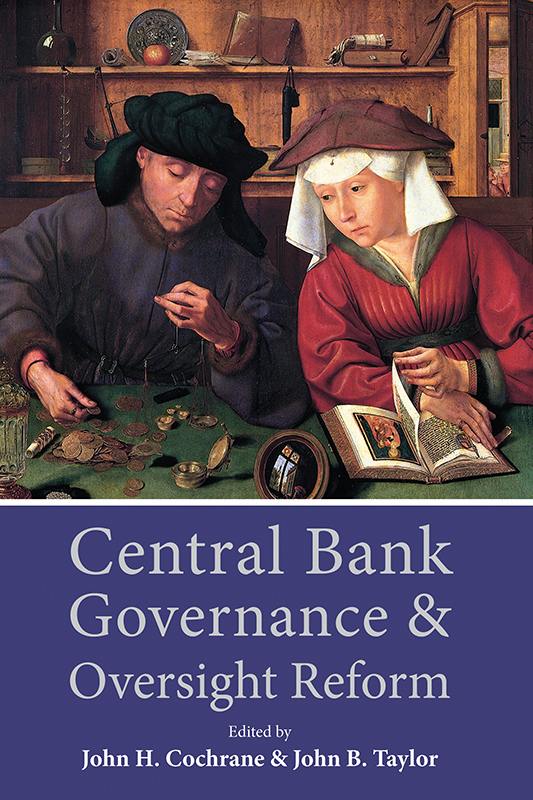
Central Bank Governance and Oversight Reform

The Hoover Institution Press just published "Central Bank Governance and Oversight Reform," the collected volume of papers, comments, and discussion from last May's conference here by the same name. You can get the  book or e-book here at the Hoover press or here at amazon.com. The individual chapter pdfs are available here.  Press release here.

(My modest contributions are in the preface and a discussion of Paul Tucker's Chapter 1. I agree it would be nice to have a more rule-based approach to lender of last resort and bailout functions, but wouldn't lots of equity so you don't have to mop up so often be even better?)

This is part of an emerging series of monetary policy conferences at Hoover. Tomorrow we will have a conference on international monetary policy. Stay tuned...


The blurb:
How can we balance the central bank’s authority, including independence, with accountability and constraints? Drawn from a 2015 Hoover Institution conference, this book features distinguished scholars and policy makers’ discussing this and other key questions about the Fed. Going beyond the simple decision of whether to raise interest rates, they focus on a deeper set of questions, including, among others, How should the Fed make decisions? How should the Fed govern its internal decision-making processes? What is the trade-off between greater Fed power and less Fed independence? And how should Congress, from which the Fed ultimately receives its authority, oversee the Fed?

The contributors discuss, for instance, whether central banks can both follow rule-based policy in normal times but then take a discretionary, do-what-it-takes approach to stopping financial crises. They evaluate legislation, recently proposed in the U.S. House and Senate, that would require the Fed to describe its monetary policy rule and, if and when the Fed changed or deviated from its rule, explain the reasons. And they discuss to best ways to structure a committee—like the Federal Open Market Committee, which sets interest rates—to make good decisions, as well as offer historical reflections on the governance of the Fed and much more. They conclude with an important reminder: how important it is to have a “healthy separation between government officials who are in charge of spending and those who are in charge of printing money,” the most essential part of good governance.
The contents:

Preface
By John H. Cochrane and John B. Taylor

Chapter 1: How Can Central Banks Deliver Credible Commitment and Be “Emergency Institutions”?
By Paul Tucker

Chapter 2: Policy Rule Legislation in Practice
By David H. Papell, Alex Nikolsko-Rzhevskyy and Ruxandra Prodan

Chapter 3: Goals versus Rules as Central Bank Performance Measures
By Carl E. Walsh

Chapter 4: Institutional Design: Deliberations, Decisions, and Committee Dynamics
By Kevin M. Warsh

Chapter 5: Some Historical Reflections on the Governance of the Federal Reserve
By Michael D. Bordo

Chapter 6: Panel on Independence, Accountability, and Transparency in Central Bank Governance
By Charles I. Plosser, George P. Shultz, and John C. Williams

Sabtu, 30 April 2016

Equity-financed banking

My dream of equity-financed banking may be coming true under our noses. In "the Uberization of banking" Andy Kessler at the WSJ reports on SoFi, a "fintech" company. The article is mostly about the human-interest story of its co-founder Mike Cagney. But the interspersed economics are interesting.

SoFi started by making student loans to Stanford MBAs, after figuring out that the default rate on such loans is basically zero. It
has since expanded to student loans more generally and added mortgages, personal loans and wealth management. Mr. Cagney says SoFi has done 150,000 loans totaling $10 billion and is currently at a $1 billion monthly loan-origination rate. 
Where does the money come from?
SoFi doesn’t take deposits, so it’s FDIC-free. ... Instead, SoFi raises money for its loans, most recently $1 billion from SoftBank and the hedge fund Third Point, in exchange for about a quarter of the company. SoFi uses this expanded balance sheet to make loans and then securitize many of them to sell them off to investors so it can make more loans
Just to bash the point home, consider what this means:
  • A "bank" (in the economic, not legal sense) can finance loans, raising money essentially all from equity and no conventional debt. And it can offer competitive borrowing rates -- the supposedly too-high "cost of equity" is illusory.
     
  • There is no necessary link between the business of taking and servicing deposits and that of making loans. Banks need not (try to) "transform" maturity or risk.
     
  • To the extent that the bank wants to boost up the risk and return of its equity, it can do so by securitizing loans rather than by borrowing. (Securitized loans are not leverage -- there is no promise of your money back when you want it. Investors bear any losses immediately and without recourse.)
     
  • Equity-financed banking can emerge without new regulations, or a big new Policy Initiative.  It's enough to have relief from old regulations ("FDIC-free").
     
  • Since it makes no fixed-value promises, this structure is essentially run free and can't cause or contribute to a financial crisis. 

More. SoFi does not use the standard methods of evaluating credit risk:
Instead of relying on notoriously inaccurate backward-looking FICO scores, SoFi is “forward-looking.” That means asking basic questions—“Do you make more money than you spend?”—and calibrating where applicants went to college, how long they’ve been employed, how stable their income is likely to be over time.
Why can’t banks do this? Because if you use depositor money for loans, as all banks do, you fall under the jurisdiction of the Federal Deposit Insurance Corp. and the Community Reinvestment Act,...
And Basel and the FSOC and the Fed and so forth. FICO score based mechanical lending standards are also demanded by government-backed securitizers Fannie and Freddie.

Yes, bank "safety" regulations demand that banks purposely lend to people that one can pretty clearly see will not pay it back, and demand that they do not lend money to people that one can pretty clearly see will pay it back.

Now, what will the regulatory response be to this sort of innovation? The right answer, of course, should be hosannas: You have introduced run-free banking, that solves all the financial-crisis worries that 90 years of bank regulation could not solve. Let this spread, and the army of bank regulators, lobbyists, lawyers, and associated politicians can all go, well, drive for Uber.

Somehow I doubt that will be the response from foresaid army. And SoFi might well want to invest in its own lawyers, lobbyists and politicians in today's America.
Rather than by the FDIC, SoFi is monitored by the Consumer Financial Protection Bureau. The overbearing regulator that was Elizabeth Warren’s brainchild thus far hasn’t come down on SoFi—the CFPB is perhaps too preoccupied with using “disparate impact” analysis of old-school auto-loan businesses to focus on a relatively exotic, app-based form of banking. But Mr. Cagney should watch his back.
Indeed he should. In today's rather rule-free environment, the CFPB -- or Department of Justice -- might just discover it doesn't like the demographics of Stanford MBAs as target borrowers.
He’d like to get a national lending license, but that would entail federal-oversight entanglements he’d rather avoid.
If he can.

A little puzzle crops up at the end. For now, I gather SoFi does not issue public equity. The plan for expansion is
insurance companies and sovereign-wealth funds might rent him their balance sheets. 
I'm not sure what "rent a balance sheet" means, but it sounds a lot like private equity or long term debt.  It would be even better for stability and low cost to issue public equity, which is liquid -- investors who need money fast can sell. But public equity comes with its own regulatory scrutiny, and perhaps even that is too much for innovation these days.

Selasa, 19 April 2016

Chari and Kehoe on Bailouts

V. V. Chari and Pat Kehoe have a very nice article on bank reform, "A Proposal to Eliminate the Distortions Caused by Bailouts," backed up by a serious academic paper.

Their bottom line proposal is a limit on debt to equity ratios, rising with size. This is, I think, a close cousin to my view that a Pigouvian tax on debt could substitute for much of our regulation.

Banks pose a classic moral hazard problem. In a financial crisis, governments are tempted to bail out bank creditors. Knowing they will do so, bankers take too much risk and people lend to too risky banks. The riskier the bank, the stronger the governments' temptation to bail it out ex-post.

Chari and Pat write with a beautifully disciplined economic perspective: Don't argue about transfers, as rhetorically and politically effective as that might be, but identify the distortion and the resulting inefficiency. Who cares about bailouts? Well, taxpayers obviously. But economists shouldn't worry primarily about this as a transfer. The economic problem is the distortion that higher tax rates impose on the economy. Second, there is a subsidy distortion that bailed out firms and creditors expand at the expense of other, more profitable activities. Third there is a debt and size distortion. Since debt is bailed out but not equity, we get more debt, and the banks who can get bailouts become inefficiently large.
For sake of argument, I think, Chari and Pat take a benign view of orderly resolution and living wills. Their point is that even this is not enough. Though functioning resolution would solve the tax distortion and subsidy distortion, the debt-size externality remains.
The extent of regulator intervention depends on the aggregate losses due to threatened bankruptcies. Individual firms do not internalize the effect of their decisions on aggregate outcomes and, therefore, on the extent of such intervention. Just as with bailouts, individual firms have incentives to become too large relative to the sustainably efficient outcome 
Their alternative: A regulatory system that
limits the debt-equity ratio of financial firms and imposes a Pigouvian tax on the size of these firms.
The paper is not specific beyond this suggestion. It's intriguing for many reasons outside the paper.

First, they limit the ratio of debt to equity, not the ratio of debt to assets. Current bank regulation is centered on the ratio of debt to assets, but then we get in to the mess of measuring risk-weighted assets, many of them at book value.  Abandoning this whole mess is a great idea.

Thinking about some of the same issues, I came to the conclusion that a simple Pigouvian tax on debt would work better than current debt-to-asset regulations. If you borrow $1 (especially short) you pay an 5 cent tax per year.

There is an interesting question then whether this tax on debt or a regulatory debt-to-equity ratio limit will work better.

Chari and Pat don't say what the optimal debt/equity ratio should be, and how that should be enforced dynamically. If up against the limit, do they want banks to sell assets ("Fire sales" and "liquidity spirals" banks will complain), to issue equity ("agency costs", banks will complain) or what?  Chari and Pat also don't say whether they want regulators to target the ratio of debt to book value of equity or to market value of equity. I like market value, further avoiding accounting shenanigans. I suspect the regulatory community will choose book value, so inure themselves from responding to market signals.

I like announcing a price rather than a quantity -- a Pigouvian tax on debt rather than a debt-equity ratio -- as it avoids the whole argument, and the just this side vs. just that side of any cliff.   My tax could rise with size, to address their size externality as well.

But they don't analyze the idea of a tax on debt rather than their ratio, so perhaps both would work as well within their model. Their ratio of debt to equity is sufficient for their ends, but perhaps not necessary.

Chari and Pat take a benign view of debt, and the functioning of resolution authority: They
start from the perspective that because debt contracts are widespread, they must be privately valuable and, in all likelihood, also valuable to society in general.
They also posit that "orderly resolution" authority will in fact swiftly impose losses on creditors, and that by using "living wills" the offending banks can be quickly broken up.

I think they make these assumptions to focus on one issue. That's good for an academic paper. But in contemplating a larger regulatory scheme, I think we should question both assumptions.

In a modern economy, liquidity need not require fixed value, and I think we could get by with a lot less debt.  That leads me to much more capital overall. They implicitly head this way,  presuming that debt is vital, but then advocating debt equity ratio regulations that will presumably mean a lot more equity.

I suspect that resolution authorities, hearing screaming on the phone from large financial institution creditors of a troubled bank,  and with "systemic" and "contagion" in mind, will swiftly bail out creditors once again.  I think that a bank too complex to go through bankruptcy, even a reformed bankruptcy code, is hopeless for the poor Treasury secretary to carve up in a weekend. So another reason for more equity is to avoid this system that will not work, as well as to patch up its remaining limitations even if it works perfectly.

Chari and Pat also step outside the model, stating that the resolution authority
is worrisome because by giving extraordinary powers to regulators, it allows them to rewrite private contracts between borrowers and creditors...[this]... can do great harm to the well-being of their citizens. Societies prosper when citizens are confident that contracts they enter will be enforced
Their closing sentence is important
We emphasize that regulation is needed in our framework not because markets on their own lead to inefficient outcomes, but because well-meaning governments that lack commitment introduce distortions and externalities that need to be corrected.

Sabtu, 16 April 2016

A better living will


"US rejects 'living wills' of 5 banks," from FT. WSJ puts this event in the larger story of Dodd Frank unraveling. Juicy quotes:
WSJ: “living wills,” ... are supposed to show in detail how these banking titans, in the event of failure, could be placed into bankruptcy without wrecking the financial system.

FT:...the shortcomings varied by bank but included flawed computer models; inadequate estimates of liquidity needs; questionable assumptions about the capital required to be wound up; and unacceptable judgments on when to enter banktruptcy.

FT: David Hirschmann of the US Chamber of Commerce, the biggest business lobby, said the living wills process was “broken”. “When you can’t comply no matter how much money you put into legitimately trying to comply, maybe it’s time to ask: did we get the test wrong?” he said.

WSJ: Six years after the law was passed, and eight years since the financial crisis, regulators given broad authority to remake American finance, with thousands of regulatory officials on their payroll, cannot figure out a system to allow financial giants to fail, even in theory. What are we paying these people for?
It seems like a good moment to revisit an idea buried deep in "Toward a run-free financial system."  How could we structure banks to fail transparently?


Picture of bank structure

Recall, here is how banks are structured now (extremely simplified). Banks hold assets like loans, mortgages and securities. Banks get money to fund these assets by selling a tiny amount of equity, i.e. stock, and by a huge amount of borrowing, including deposits, long-term bonds, and short-term debt.

The trouble with this system is, if the value of the assets falls by more than $10 in my example, the equity is wiped out, and the bank can't pay its debts. If short-term debt holders worry about this event, they all clamor to get paid first, so a run can happen. That's not really a problem either; bankruptcy is set up exactly to handle this situation. The creditors who lent money to the bank split up the assets. Yes, they don't get their full money back, but if you lend to a bank that's leveraged like this, that's the risk you take.

The trouble is the widespread feeling that big banks are too big, too complex, too illiquid, to utterly muddy, to carve up this way. If it takes years in court, and if all the value of the assets is drained away by lawyers, you have a real problem. Furthermore, we often want the profitable parts of the bank to remain in operation while the creditors squabble about assets. (Ben Bernanke's classic paper on banking in the great depression makes this point beautifully.) The ATM machines should not go dark, the offices where people know their customers and can keep things going should stay in operation.

Hence, big banks become too big -- or too something -- to fail. In that situation, the government is mighty tempted to bail out the creditors and keep the thing limping along. Given that temptation, a lot of large, politically well connected creditors also scream that there will be ``systemic dangers'' if they don't get their cash now, adding to the bailout pressure. A "living will" is supposed to stop this chain, by allowing  bank assets to very quickly get divvied up among creditors.

But the large banks are, apparently, so large and complex that nobody can figure out a living will. That's debateable, for example Kenneth Scott and John Taylor argue bankruptcy can work.  But let's go with the idea. Is there an alternative to Bernie Sanders' bust up the banks? Here's one.

picture of altered bank structure that is easy to resolve


Starting from the left, suppose the bank holds all the same assets it does today. But, it issues 100% equity to finance its assets. Now, a 100% equity financed bank cannot fail. If you don't have any debt, you can't fail to pay debts. Yes, the bank can lose money and slowly go out of business. But it cannot go bankrupt. As it loses money, the value of its equity declines, until shareholders get mad and liquidate the carcass. Nobody can run to get their money out ahead of the other person. End of bankruptcy, end of bank runs, end of financial crises.

(Technical note. Yes, that's a bit overstated. A bank can potentially invest in derivatives and other securities where it can lose more than all of the investment. The amount of monitoring needed to make sure this doesn't happen is trivial next to the Basel sort of thing required to make sure a bank never loses more than a few percent of its value.)

OK, gulp, you say. But don't people "need" to have bank accounts? Isn't "transformation" of debt into loans the crucial feature of the financial system? Don't equity holders "require" high risk, high-return stock? No, argues the "run-free financial system" essay. But let's not go there. Let's just restructure things so that the bank can hold exactly the same assets it has today, and its investors can hold exactly the same assets they hold today.

So, moving to the right in my little picture, suppose bank stock is held in a mutual fund, exchange traded fund, or a special-purpose "bank." Bank stock is the only asset these companies hold, and that stock is also traded on exchanges. These banks fund themselves by the same mix of debt, equity, deposits, and heck even overnight wholesale debt, commercial paper, and so forth.

Now, if the value of the bank stock falls, these holding companies fail, just as my original bank failed. But there is a huge difference. You can resolve the holding company in a morning and still make it to play golf in the afternoon.  The only asset is common stock, commonly traded! There are no derivatives positions to unwind, no strange positions in offshore investment trusts, or whatever.  The "living will" simply specifies how much common equity each debtholder gets in the event of bankruptcy. There is never any need to break up, liquidate, assess, or transfer bits and pieces of the big bank.

Furthermore, there is no more obscurity over the value of  the holding company assets. We see the value of bank assets, marked to market, on a millisecond basis.

The holding companies can provide all the retail deposit services banks now provide. In fact, they could contract out to the banks to provide those on a fee basis, so the customer might not even need to know.

In addition, any sane holding company would hold the stock of several banks, diversifying the risk, and thus reducing the chances of ever needing to be wound up. Come to think of it, any sane holding company would also diversify out of banking, but now we're back to my larger vision of equity-financed banking and sensible small changes in financial structure to achieve it.

In the meantime, there you have it. 100% equity financed banks can still give bank creditors exactly the same assets they hold today, and allow failures of those debts to be resolved in a morning.