Senin, 16 November 2015

Four ways you can import a patient picture into Dentrix


You step into your reception room to bring your patient, Carrie, into the treatment room and you realize there are two patients sitting there who are about the same age. Who is Carrie? You have never met her so you just throw her name out there and see who responds. Wouldn’t it be nice if you could prepare yourself a little bit more by having a current picture of Carrie?

There are a few different ways to pull in a picture of your patients, depending on which imaging software you are using and if you want to use a webcam. There is an icon on your toolbar for Patient Picture, which has four options for importing your patient picture.
  • If you have a webcam installed on your front office computer, you can use the Acquire feature and select the webcam or iPad to take a picture. I have an office that has started using an iPad as their webcam and it is working great.
  • Many practices are using a digital camera for intraoral images and saving the images in some kind of image gallery software. If you know the location of the images, you can use the Import from File feature to pull in your patient picture.
  • For the offices that are using DEXIS, using the Copy from Clipboard feature is the easiest feature to use in my opinion. From your Dentrix patient chart, double click on the image you want to use as your patient picture (many of my offices are using their intraoral camera to take a face shot), then click on the arrow on the top toolbar and click on copy to clipboard. Then, open the Patient Picture icon and click on Paste from Clipboard.
  • For the offices that are not using DEXIS for your imaging software, using the Screen Capture feature to acquire the patient picture will be the best option for you. Open your imaging software so you have the picture you want to import in view, then open the Patient Picture icon in Dentrix. Click on the Screen Capture feature and your cursor will change shape so you can make a box around the picture and it will appear in the Patient Picture window.

Click Save and you now have a current snapshot of your patient. This will eliminate the guesswork when you walk out to the reception room to summon your patient.

Kamis, 12 November 2015

Permazero

St. Louis Fed President Jim Bullard gave a very interesting paper at the Cato monetary conference, with this great title.

Jim starts with this great picture. It's a simulation of the standard three equation new Keynesian model as we go from 2% interest rate to zero. This is an upside down version of the first graph in my "Do higher interest rates raise or lower inflation." (Blog post) But Jim makes a new and insightful point with it, that had not occurred to me.

Jim reads this as an account of what happened in 2008, not (my) tentative prediction for what might happen in 2016 in the other direction. It's compelling: The Fed lowers rates. This boosts output (black line) over what it would otherwise be, overcoming the horrendous negative shocks to the economy from a financial crisis. Inflation gently declines, which is also what inflation did after a one time shock in 2009, related to the output shock which the Fed was offsetting.


Jim then ties that together with my Figure 3 in an artful way. The same model that accounts well for slow disinflation in the recovery suggests that raising rates now, in the absence of other shocks, would just raise inflation and lower output.


Jim goes on to present some data averaged across a variety of countries. Here you see a pattern quite similar to the model's prediction. After recovering from the severe shock, inflation starts its gentle decline.

Like me, Jim is nervous about these conclusions. The data seem to be telling us that interest rate pegs are not unstable. The standard model turns out to have that prediction, but also predicts that raising interest rates, while lowering output as we have long been told, will just smoothly raise inflation. It's very hard to turn around decades of contrary doctrine -- that pegs are unstable, and raising rates lowers inflation. One should be nervous about such conclusions. Maybe inflation is, finally, just around the corner. So Jim makes very clear he's not yet recommending a rate rise to cause more inflation!

But one should also start thinking about what these conclusions mean if they are right, and Jim summarizes with a number of such implications. A few that seem especially important, with comment:
Third, longer‐run economic growth would still be driven by human capital accumulation and technological progress, as always, but without the accompanying stabilization policy as conventionally practiced from 1984‐2007. In principle, the economy would still be expected to grow at a pace dictated by fundamentals.
A little more bluntly, Japan-bashers cannot blame 20 years of poor growth on the zero bound. Nor should we worry that permazero will cause lower growth. (The other way around is much more likely: low marginal product of capital leads to low rates.) Japan's growth and inflation, like our own for the last seven years, has also been quite stable, raising the next question of just how much stabilization this policy was doing.
Fourth, the celebrated Friedman rule would arguably be achieved, so that household and business cash needs are satiated. In many monetary models this is a desirable state of affairs.
Yes!! Shout it from the rooftops.

Just what is so terrible about zero rates and very low inflation? Zero rates are the optimum quantity of money. They have financial stability benefits too. Banks sitting on huge piles of cash don't go under.

Conventional modeling has been treating the zero bound as a "trap," or a terrible outcome to be avoided. But it's a honey trap, at least in these models. The main complaint one could make is that they don't last, that they lead to spiraling deflation or hyperinflation. But the models said "trap" -- they last -- and the data seem to agree.
Fifth, the risk of asset price fluctuations may be high. In the New Keynesian model, the near‐zero interest rate policy with little or no response to incoming shocks is associated with equilibrium indeterminacy. This means there are many possible equilibria, all of which are consistent with rational expectations and market clearing. In a nutshell, a lot of things can happen. Many of the possible equilibria are exceptionally volatile. One could interpret this theoretical situation as consistent with the idea that excessive asset price volatility is a risk.
This is spot on. In the models, the trouble with the zero bound "trap" is not high unemployment, low growth, or spiraling inflation or deflation -- it has none of these. The problem is "indeterminacy," the possibility that inflation can bounce around a bit, each time returning stably back again. That's also what we seem to see, and it hasn't been a huge problem: We don't see any more inflation, output, or asset market volatility in the last 7 years than in the period before the crisis.

And this is a simple problem to solve in the theory. Add back the missing fiscal theory of the price level -- deliberately thrown out in the theory -- and you have determinacy again. In words, a jump to an alternative equilibrium requires that fiscal policy expectations also jump. If people's expectations of long-term fiscal policy are stable, then we have determinacy and no more volatility at the zero bound too.
Sixth, and finally, the limits on operating monetary policy through ordinary short‐term nominal interest rate adjustment in this situation would surely continue to fire a search for alternative ways to conduct monetary stabilization policy. The favored approach during the past five years within the G‐7 economies has been quantitative easing, and there would surely be pressure to use this or related tools.
I.e. in permazero, eventually markets get tired of reacting to whispers that the Fed might someday raise rates. Monetary policy overall becomes ineffective, leading central banks to try other levers. Which may not be such a great idea!

Selasa, 10 November 2015

Taylor Truman Medal Speech

John Taylor's speech  on receiving the Truman medal for economic policy is noteworthy. John thinks about the institutions that govern monetary and financial policy. We spend too much time on the will-she-raise-rates-or-won't-she sort of decisions that we forget how important this institutional structure is to good, predictable and (as John might put it) rule-based policy.

John reflects on the institutions of postwar policy:
Seventy years ago Harry Truman signed the Bretton Woods Agreements Act of 1945. It officially created two new economic institutions: the International Monetary Fund and the World Bank. A year later he signed the Employment Act of 1946. It created two more new institutions: the President’s Council of Economic Advisers (CEA) and the Congress’s Joint Economic Committee (JEC). And in 1947 came the General Agreement on Tariffs and Trade (GATT) and the Truman Doctrine, and in 1948 the Marshall Plan.

Prewar problems:
... One serious economic evil leading up to World War II arose from competitive devaluations and currency wars...
A second economic evil stemmed from extensive “exchange controls,” in which importers of goods were forced to make payments to a government monopoly in foreign exchange. The government would determine what types of goods could be imported and how much to pay exporters. Exchange controls also involved multiple exchange rates, government licenses to export and import, and even officially conducted barter trade. They deviated from the principles of economic freedom, and caused all sorts of distortions and injustices...
Bretton Woods:
Each country—each party to the agreement—would commit to two basic monetary rules... First, they would swear off competitive devaluations by agreeing that any exchange rate change over 10% from certain values, or pegs, would have to be approved by a newly-created IMF. ... It was called an adjustable peg system.
Second, countries agreed to remove their exchange controls, with a transition period because many had extensive controls in place. The countries, however, did not agree to remove capital controls, which include restrictions on making loans, buying or selling bonds, and equity investments.
John's judgement:
In important respects the blueprint succeeded. Exchange controls were removed, though it took more than a decade, and the currency wars ended, though the adjustable peg system itself fell apart in the 1970s and gave way to a flexible exchange rate system. The 1970s were difficult because monetary policy lost its rules-based footing and both inflation and unemployment rose. 
But in the 1980s and 1990s policy became more focused and rules-based and economic performance improved greatly. Though not part of the blueprint, virtually all the developed countries that signed the original agreement—and others like Germany and Japan—also abandoned capital controls. By the late 1990s, many emerging market countries were adopting rules-based monetary policies, usually in the form of inflation targeting, and entered into a period of stability. Some emerging market countries, such as Brazil, began to remove capital controls, and the IMF recommended adding their removal to the articles of agreement.
I'm a bit skeptical of this judgement. (And I think I've persuaded John, so we'll see what happens in later writings.) Bretton Woods featured pegged exchange rates, something of a gold standard to the dollar, and capital controls to lessen exchange rate pressures. All three blew up by 1970. The basic structure of Bretton Woods failed.

The restoration of order in the 1980s featured important reforms to monetary and fiscal policies internationally, and the Bretton Woods institutions (IMF, CEA, etc.) may have had something to do with it. But Bretton Woods was gone.

Bretton Woods did, however, help to keep the chaos of the 1930s from returning. John's point may be that bad rules are better than no rules.

On to the present:
Unfortunately this benign situation has not held, and today the challenges facing the international monetary system eerily resemble those at the time of the creation...
Consider currency movements. Quantitative easing (QE) started in earnest in 2009 in the United States. It was followed by a period where the dollar was low relative yen. It was followed by QE in Japan in 2013 which depreciated the yen, as was the expressed intent of Japan governor Haruhiko Kuroda. That was followed by QE in the Eurozone in 2014 which depreciated the euro, as was the expressed intent of ECB president Mario Draghi. The dollar- yen-euro story from 2009 to 2014 looks a lot like the pound-dollar-lira story from 1931 to 1936, even though U.S policy makers today consider the exchange rate effect to be by-products of their actions, not the direct intent. So QE begets QE, which begets QE, and so on.
There is a big challenge understanding just how QE affects currencies. Notice John says "followed by." But if you regard QE as signals of future interest rates, it is easier to understand. Exchange rates are a sort of present value of future interest differentials.  Continuing
Interest rate decisions at central banks around the world also resemble currency wars. Whether you ask them or watch them, you can tell that central bankers are following each other. Extra low U.S. interest rates were followed by extra low interest rates in many other countries, in an effort to prevent sharp currency appreciations. Those low interest rates appear to have resulted in a boom-bust pattern in emerging market countries evident in the recent commodity cycle...
Capital also flows in response to interest rate differentials—even if attenuated by policy reactions. .. A host of government interventions and restrictions on housing markets have been used to prevent the low interest rates from causing bubbles. Macro-prudential regulations, which have legitimate purposes, are also being used to counter the effects of the low interest rates.
Worse,
There’s also been a revival of capital controls. Even the IMF has endorsed capital controls, calling them “capital flow management” or CFM for short.
John's conclusion
In my view we need a new strategy to deal with these problems.
So as in the 1940s we should forge an agreement where each country commits to certain rules... 
. A second reform would set up rules for eventually removing capital controls. Currently, 36 countries now have open capital accounts, but 48 are classified as “gate” countries and 16 as “wall” countries with varying degrees of capital controls.
John rethinks the role of the 40s institutions.
.. recreating the ‘40s founded institutions for today’s global economy must go beyond the IMF. The World Bank was originally created to supplement private capital flows for reconstruction and development. But today capital flows and savings to finance investment are abundant—some even see a glut.
He goes on to rethink the roles of CEA, JEC, GATT, WTO, and so forth.

Last but not least, international economic policy and foreign policy are intertwined. The Bretton Woods generation understood that.
...we see the same international cross-border encroachment on freedom, including economic freedom. In my view the United States should commit to promoting economic freedom as part of its foreign policy strategy. It should also strongly support economic leaders who are committed to economic freedom in their own countries. This is the lesson learned from the transitions from government control to market economies two decades ago, especially in Poland. The U.S. government strongly supported Polish economic reforms—the removal of price controls, of barriers to new businesses, and of subsidies of old state enterprises, along with a restoration of the rule of law and property rights. Today international support packages tend to do just the opposite: encourage more government subsidies and controls.
It is amazing just how much of the international financial and monetary architecture resides in institutions set up in the 1940s. Good rules need good institutions. But institutions need rethinking on occasion.

Senin, 09 November 2015

Top 10 features in Dentrix you are not using


In 2003, my dental practice converted from an archaic DOS-based dental software to the impressive and robust Dentrix practice management software. To say the least, I was completely overwhelmed. Two years later, in 2005, I still felt like I hadn’t even scratched the surface of my new powerful software’s potential so I applied to become a Certified Dentrix Trainer in order to learn everything there was to know about the Dentrix program. What better way to learn than to get a certificate?

Now I know that not everyone has the opportunity to become a Dentrix trainer like I did, but with a little self-motivation and some tips from me, you will be well on your way to being a “Dentrix super user.” Since I am working with dental practices every day, I have the unique opportunity to see what features they are using, what features they are not using, and what features they have no idea even exist. My goal today is to give you my top 10 you might not even know exist.
  1. Quick Letters and Letter Merge – Maybe this sounds familiar . . . you have a folder on your desktop with all of your office’s letters you send out to patients, including collection letters, welcome letters, and letters to specialists. When it is time to send a letter, you edit the date, enter the patient’s name, address, and salutation, then sign the letter and scan it into the document center. That process sounds like a lot of work to me. Why not add your custom letters into the Quick Letters or Letter Merge with the proper merge fields and let Dentrix do all the work for you? The best part is it will automatically put a note on the Office Journal and you can “Send to the Dentrix Document Center” without scanning (see #5 on the list).  Here are some more blog posts related to this feature . . .
    1. Send letters that make an impact . . . CLICK HERE
    2. Can you write me an excuse note . . . CLICK HERE
  2. Dentrix Mobile – Have you ever been sitting in the comfort of your home watching the weather forecast and hoping that the power doesn’t go out … then suddenly there’s nothing but darkness. You check the office and the power is also out there … so how are you going to let your patients know not to come in? Has your doctor ever been out of town and received a call from a patient requesting a drug refill but he or she has no way of checking the last prescription or the patient’s last visit unless he or she goes into the office? Both of these two common scenarios can be solved just by registering for Dentrix Mobile. It’s included in your Dentrix customer support plan so there is absolutely no excuse for not using this service.
    1. Three reasons you should be using Dentrix Mobile . . . CLICK HERE
    2. A lifeline to your patient info . . . CLICK HERE
  3. Payment Agreements – I wrote an article called “Get it out of your head and into the computer” back in April 2014. The theme of the article was speaking to office managers who store all their verbal payment agreements in their head. What I am seeing is this is still happening, but I am also seeing new doctors purchasing practices with a significant amount of the accounts receivable over 90 days past due or new office managers taking over a practice where there has been no management of the accounts receivable. Using the Payment Agreement feature in Dentrix will not only help you get organized with patients who are making payments, but also allow the entire team to see on the ledger what the arrangement is with the account.
    1. Two options to help you manage your A/R . . . CLICK HERE
    2. Get the info out of your head and into the computer . . . CLICK HERE
  4. Tracking Gratuities and Referrals - Do you know where your new patients are coming from? Are they hearing about you from friends, Google Search, or the ValPak flyer that cost you $15,000 to send out? Your marketing dollars depend on where patients are being referred from so you should know where to continue spending money and where to stop. When a patient refers a new patient, do you give him or her a thank you gift? Would you like to track if you gave the referral source a Starbucks or Home Depot gift card last time or be able to track a referral source’s gratuity history? Tracking referrals and gratuities in Dentrix is super easy and gives the doctor a lot of good information about where to spend marketing dollars … but I find most offices never use this useful tool.
    1. Building relationships one referral at a time . . . CLICK HERE
    2. Keep tight reins on your referred patients . . . CLICK HERE
  5. Sending to the Dentrix Document Center – This will save your team a ton of time in unnecessary scanning, unnecessary wasted paper, and unnecessary hard drive storage space. When you scan a document into the Document Center, it takes many more steps and the file size of a scanned document is about 100 times larger (just a guess) than that of a file send electronically through the Dentrix Document Center printer driver. Anything you want to print can be virtually printed to the Document Center for file storage. This is such an amazing yet underused feature.
    1. A little known secret . . . CLICK HERE
  6. Perfect Day Scheduling – Close your eyes for a moment and imagine if you could see your patients on time, complete 80% of your production goal before lunch, get out for lunch on time, and finish your day without pulling the roller skates out of the closet. This can be a reality if you create it. Take control of your appointment book with Perfect Day Scheduling. When you use perfect day scheduling, your team knows exactly how to schedule because you have mapped it out for them. There is no room for error.
    1. What if everyday could be a perfect day . . . CLICK HERE
    2. The new patient experience, scheduling the appointment . . . CLICK HERE
  7. Goal Tracking – Every dental practice has production and collection goals they need to meet in order to keep the financial state of the business healthy. I always encourage doctors to share these goals with the team and be transparent with the key performance numbers with the team. There are several places in Dentrix to watch and monitor your practice goals so the team can strategize and work together on exceeding the goals. You can monitor your goals on the monthly calendar, Practice Advisor Report, and the Daily Huddle.
    1. Let's do some goal setting . . . CLICK HERE
    2. Looking ahead to  . . . CLICK HERE
  8. More Information Button – Have you ever been on the phone with a mom and she wants to know when her three kids and husband are scheduled next for all their future appointments … but you’re not sure what’s the most efficient way to find all these appointments for the entire family? Try the More Information button and I can guarantee you will fall in love with this super quick search tool. You can find the More Information feature on all Dentrix modules. When you are selecting a patient anywhere in Dentrix, you will see it at the lower left corner of the window.
  9. Create Batch of Primary Dental Claims – Are you sure you have batched and sent off all your insurance claims from last week? How about last month? Use this second pair of eyes to double check and make sure all your claims have been sent out. Not only will this give you peace of mind, but also keep your accounts receivable out of the 90-day past due column.
    1. Are all your insurance claims going out . . . CLICK HERE
  10. Patient-Friendly Descriptions – Do your patients often ask what a “resin 2surf, post” or a “Crown-porc fused noble metal” is? Or is your practice in an area where English is not the primary language for many of your patients? If you would like to create a treatment plan that your patients would more easily understand and helps them understand what each procedure is, then start using patient-friendly descriptions. With Dentrix G6.1, it is even easier to use because you can edit these descriptions in the procedure code edit.
    1. No speak English, no worries . . . CLICK HERE

Have fun experimenting with these features and working toward increasing your level of efficiency and customer service. Drop me a line at dayna@raedentalmanagement.comif you have other questions. I’m happy to help.

Minggu, 08 November 2015

The 13 Trillion Dollar Question

On Tuesday Nov 10 there will be a conference in Chicago on "The $13 Trillion Question: Managing the U.S. Government’s Debt" hosted by the Initiative on Global Markets at Chicago Booth, and the Hutchins Center on Fiscal and Monetary Policy at Brookings. (The Brookings announcement here.)

Robin Greenwood will present "The Optimal Maturity of Government Debt and Debt Management Conflicts between the U.S. Treasury and the Federal Reserve" arguing that the Fed and Treasury are working to cross-purposes -- the Fed buys what the Treasury sells -- and that the government  should go after low rates on long term bonds rather than the budget insurance of issuing long term bonds.

(The government faces the same decision a homeowner does: borrow at near-zero floating rates,  but maybe rates shoot up and so do your payments, or borrow long at 2% rates, and pay more if rates don't go up. Robin and Larry favor the former. I'm more risk averse. Maybe living in California has sensitized me  that just because you haven't seen an earthquake recently doesn't mean you shouldn't buy earthquake insurance. But it's a good argument to have qualitatively -- what's the risk, and what's the reward.)

I will present "A new structure for Federal Debt," arguing for an overhaul of which instruments the Treasury issues, to make them more useful for financial markets and financial stability as well as for government borrowing and risk management. (Earlier blog post about this paper here.)

There will be extensive discussion and broader issues, and (the big draw) a panel of Seth  Carpenter, Charles Evans, and Sara Sprung, moderated by David Wessel.

The conference is by invitation, but you can still sign up here until they run out of room, or email Jennifer (dot) Williams at chicagobooth (dot) edu. It will also be viewable by live webcast, link here, starting 1:30 central.

Update: Video of the event here.


Program

Session I - The Optimal Maturity of Government Debt and Debt Management Conflicts between the U.S. Treasury and the Federal Reserve

Speakers

Robin Greenwood, George Gund Professor of Finance and Banking, Harvard Business School
Samuel G. Hanson, Assistant Professor of Business Administration, Harvard Business School

Discussant

Guido Lorenzoni, Breen Family Professor, Northwestern University

Moderator

Austan Goolsbee, Robert P. Gwinn Professor of Economics, University of Chicago Booth School of Business

Session II - A New Structure for U.S. Federal Debt

Speaker

John H. Cochrane, Senior Fellow, Hoover Institution and Distinguished Senior Fellow, University of Chicago Booth School of Business

Discussant

James J. McAndrews, Executive Vice President, Federal Reserve Bank of New York

Moderator

Anil K Kashyap, Edward Eagle Brown Professor of Economics and Finance, University of Chicago Booth School of Business

Session III - Panel Discussion

Panelists

Seth B. Carpenter, Assistant Secretary for Financial Markets, Department of the Treasury
Charles Evans, President and Chief Executive Officer, Federal Reserve Bank of Chicago
Sara Sprung, Managing Director, Neuberger Berman

Moderator

David Wessel, Director, The Hutchins Center on Fiscal and Monetary Policy, Brookings Institution

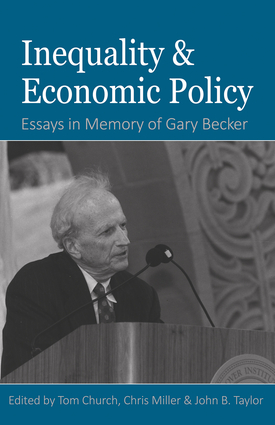
Inequality and Economic Policy Published

The Hoover Press put up for free the chapters of Inequality and Economic Policy: Essays In Memory of Gary Becker, edited by Tom Church, John Taylor, and Christopher Miller. You can of course still buy the book for a reasonable $14.95.

This includes the published version of my essay Why and How We Care about Inequality, also available on my webpage.  Bryan Caplan was kind enough to cover it positively last week, now you can read the original. I put a draft up on this blog last year, so I won't repeat it all today. As usual, the published version is better.

The rest of the contents:

Chapter 1: Background Facts By James Piereson

Chapter 2: The Broad-Based Rise in the Return to Top Talent By Joshua D. Rauh

Chapter 3: The Economic Determinants of Top Income Inequality By Charles I. Jones

Chapter 4: Intergenerational Mobility and Income Inequality By Jörg L. Spenkuch

Chapter 5: The Effects of Redistribution Policies on Growth and Employment By Casey B. Mulligan

Chapter 6: Income and Wealth in America By Kevin M. Murphy and Emmanuel Saez

Chapter 7: Conclusions and Solutions By John H. Cochrane, Lee E. Ohanian, and George P. Shultz

Chapter 8: Contents by Edward P. Lazear adn George P. Shultz

Senin, 02 November 2015

Imagine if your patient could book a hygiene visit just like making dinner reservations?


I was in an office this last week that is using a web-based software solution for their email, text messaging, appointment reminders, and appointment requests. It integrates well with Dentrix. However, when a patient requests an appointment, it becomes a challenge communicating with the patient if the appointment time isn’t available in the Dentrix appointment book. Often, what happens is that the patient assumes he or she will get the time requested when probably 9 out of 10 times the office is fully booked during the requested time. Then the patient either shows up for the appointment anyway and has to be rescheduled or the patient is frustrated because the appointment time he or she wanted is not available. There is a big difference between requesting an appointment and online booking.

What if booking your dental visit was just like making dinner reservations through OpenTable? If the patient could see only open times, then it would eliminate the frustrations between the office and the patient when the patient requests an appointment time that is not available. I know that, with the office I was in last week, this would make a world of difference. The amount of emails and voicemails that were going back and forth to try and get this patient booked was extremely time-consuming.

Now close your eyes and imagine what it would look like if the email or text message continuing care reminder contained a link where the patient could book an appointment with his or her favorite hygienist on a day and time that not only worked for the patient but is also open in the office’s Dentrix appointment book. Keep your eyes closed for a minute and imagine that you are still in full control of the situation. Yes, you say what is open and what isn’t (I know this is important because I was a scheduling coordinator once J).

Now open your eyes and let me bring you into reality with Dentrix Online Booking . . . launching in the first quarter of 2016. You can be a part of this technology movement by pre-registering for this service and receive 50% off the price. CLICK HERE to reserve your place in line.